How the implementation is organized
Config Mate separates configuration transport, serialization, and reference
resolution. The ConfigMate class coordinates these responsibilities without
embedding the details of every URI scheme or document format.
Package layout
The implementation is deliberately small:
src/config_mate/
├── __init__.py
├── main.py
└── handlers/
    ├── __init__.py
    ├── json_handler.py
    ├── xml_handler.py
    └── yaml_handler.py
config_mate.__init__defines theConfigMatefacade and the load, resolution, and dump pipeline.config_mate.maindefines the Click command, configures transport adapters, and directs output to a file or standard output.config_mate.handlersdefines the serialization abstraction and the built-in JSON, YAML, and XML implementations.session-adapterssupplies the file, S3, OCI, and authenticated HTTP transport adapters used by the CLI.jsonrefperforms recursive JSON Reference resolution.
The playground is a separate Streamlit consumer of the public ConfigMate
API. It is not part of the loading core.
Class diagram
The diagram shows the core collaboration points. ConfigMate owns the
requests session and handler registry, delegates resource access to session
adapters, delegates parsing and writing to stream handlers, and invokes
jsonref for $ref replacement.
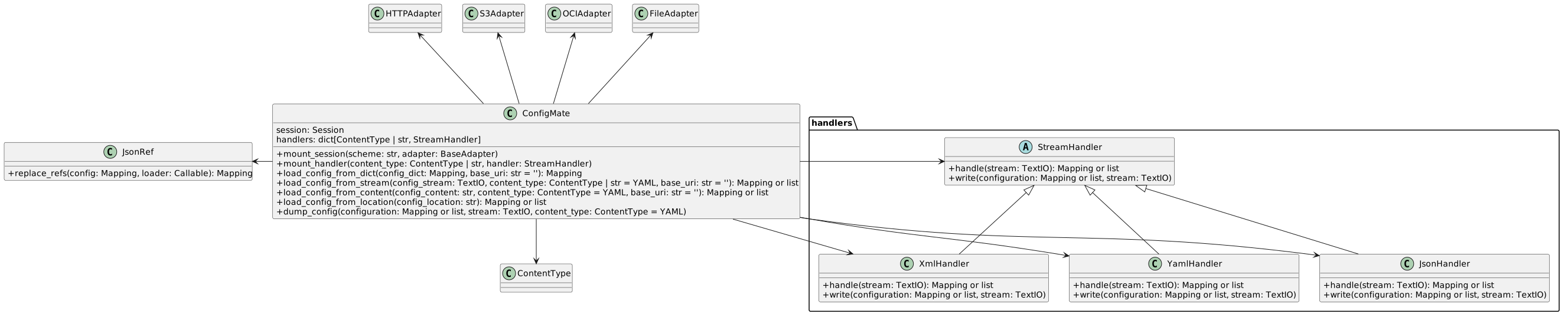
The generated SVG is based on the PlantUML source. The diagram focuses on architectural relationships; external library classes are shown only where they connect to the Config Mate core.
The loading pipeline
All input paths converge on the same pipeline:
location or content
        │
        ▼
select transport and obtain a text stream
        │
        ▼
select a handler from the content type
        │
        ▼
parse JSON, YAML, or XML into Python values
        │
        ▼
resolve $ref recursively with jsonref
        │
        ▼
return plain mappings, or a list for multiple documents
load_config_from_location() distinguishes a URI from a local filesystem
path. Local paths are converted to absolute file:// URIs, so both local and
remote resources pass through the requests session. The response content type
selects a stream handler. Gzip response bodies are detected from their magic
bytes and decompressed before parsing.
The parsed value then reaches load_config_from_dict(), which calls
jsonref.replace_refs(). Config Mate supplies load_config_from_location() as
the loader, allowing a reference discovered by jsonref to re-enter the same
transport and parsing pipeline. This is what makes references recursive across
different documents and schemes.
Reference proxies and lazy loading are disabled. Callers receive ordinary Python mappings rather than values that fetch content when later accessed or represented.
Transport adapters
requests.Session is the transport registry. The CLI mounts one adapter for
each supported scheme:
| Scheme | Adapter |
|---|---|
http://, https:// |
HTTPAdapter or BearerAuthHTTPAdapter |
file:// |
FileAdapter |
s3:// |
S3Adapter |
oci:// |
OCIAdapter |
Both the root document and any external references use the same session. Consequently, HTTP bearer authentication and OCI configuration supplied to the CLI also apply while collecting referenced resources.
The public mount_session() method makes transport support extensible. A
caller using the Python API can associate another URI scheme with any
compatible requests adapter.
Serialization handlers
StreamHandler defines two operations:
handle()parses a text stream into mappings; andwrite()serializes mappings to a text stream.
ConfigMate registers handlers by content type. Several MIME types can point
to the same handler—for example, standard JSON and problem JSON use
JsonHandler, while plain text is treated as YAML to support services that
serve YAML without a specific YAML content type.
The public mount_handler() method accepts either a ContentType or a string,
so applications can register another MIME type or replace a built-in
serialization strategy without changing the resolution pipeline.
Entrypoints
The CLI is a thin composition layer. It:
- translates
--extinto an output content type; - creates
ConfigMate; - mounts the standard transport adapters and credentials;
- loads and resolves the root location; and
- dumps the result to standard output or
--output.
The playground follows the same shape but starts from editor content, calls
load_config_from_content(), and renders the YAML result in Streamlit. Keeping
these entrypoints outside the core lets the same API serve automation,
interactive exploration, and direct Python integrations.